





political Islam
The Egyptian coup and the fate of political Islam
By Imam Zaid Shakir | Al Jazeera | 20 Jul 2013
In his, Dictionary of Political Thought, the noted political philosopher, Roger Scruton, defines a coup d’etat as "a change in government by force resulting in a change of constitution, and brought about by those who already hold some form of power whether military or political. The institution of a coup thereby transforms the terms on which their office is held from a public trust into a private possession".
Egypt’s hardline Islamist party unravels, pointing to fragility in political Islam
Source : AP | 05 Oct 2012
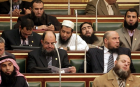
Internal feuds are threatening to unravel the political party of Egypt’s ultraconservative Islamist Salafis, as pragmatists try to shake off the control of hardline clerics who reject any compromise in their stark, puritanical version of Islam.
The fight for leadership could paralyze the Al-Nour Party, which rocketed out of nowhere to become Egypt’s second most powerful political force, behind the Muslim Brotherhood. Together, the Brotherhood and Al-Nour embodied the rise of Islamists to prominence after last year’s fall of Hosni Mubarak.
Libya drops ban on religion-based parties
Source : Agencies | Tripoli | 03 May 2012
Libya has dropped a ban against parties based on religion, tribe or ethnicity, an official said, after the law irked Islamist parties in the run up to the first free election in June.
The ruling National Transitional Council's judicial committee on Wednesday read out a raft of news laws including an amended version of one governing formation of political parties, making no mention of the ban, which was announced last week.
Political Islam Without Oil

By Thomas L. Friedman : The New York Times | Cairo | 10 Jan 2012
With the Islamist Muslim Brotherhood and the even more puritanical Salafist Al Nour Party having stunned both themselves and Egyptians by garnering more than 60 percent of the seats in Egypt’s parliamentary elections, we’re about to see a unique lab test for the Middle East: What happens when political Islam has to wrestle with modernity and globalization without oil?
Political Islam and its supposed dangers
By Abdul Bari Atwan | Middle East Monitor / 01 Dec 2011
In gaining the majority of votes in the Moroccan election, the Justice and Development Party has put the West on alert, as well as some of the more conservative Arab countries. Long-held fears have been revived by the sweeping success of political Islam across the Middle East-North Africa (MENA) region. However, such fears are misplaced because most of the Islamic parties which have seen electoral success are most definitely moderate; they believe in pluralism and coexistence with other ideologies, secularism included.